
Ngā pūrongo o Kawau
Kawau project news and key safety information
Find project newsletters and access key safety factsheets for the Kawau Island pest eradication project.
Introduction
The success of this programme, initially and long term, depends on the support and involvement of Kawau Island’s community. Auckland Council is committed to working with you, keeping you up to date and listening to your feedback.
This is your page to keep up with all the important news on the Kawau Island pest eradication programme and some of the environmental outcomes we hope to celebrate in the future.
Email us to sign up for the project newsletter. See the operational updates section for the latest information.
Safety factsheets
Information for landowners and occupiers
The project team have prepared the Kawau Island eradication project factsheet for landowners and residents (PDF 1.85MB) that outlines important information for landowners, occupiers and visitors to the island. It contains key information that is important to read.
Keeping dogs safe
Dogs are the most at-risk pets during a 1080-based pest control operation. Always supervise your dog and keep them on a leash in affected areas. Do not let them roam or eat animal remains. Consider using a muzzle. If you suspect your dog has eaten 1080 poison, make the dog vomit immediately if possible and call your vet straight away.
For those on the island, this is likely the Warkworth Vets – 09 425 8244
Alternatively, contact the Auckland Council call centre (24 hours) – 301 0101 for locations of emergency emetic medication.
Check out the dog protection factsheet (PDF 1.02MB) for further information.
Safety tips
During the operation and six months afterward:
• do not touch bait that is dyed green
• watch children at all times
• keep dogs away from poison baits and animal remains, as 1080 they are toxic to animals
• read and follow all safety signs.
National Poisons Centre
If you think someone has been poisoned, call the New Zealand National Poisons Centre immediately - 0800 764 766
Contact details
Email us at kawauislandproject@aucklandcouncil.govt.nz or phone (09) 301 0101.
Latest newsletter - July 2026
Kawau Island multi-species eradication project - Working towards a pest free Kawau Island
Additional funding announced for predator-free initiatives in Tīkapa Moana / the Hauraki Gulf
Pest-free Kawau, alongside fellow members of the “Islands of Hope” Hauraki Gulf Islands alliance, Tu Mai Taonga (Aotea / Great Barrier Island) and Te Korowai o Waiheke (Waiheke Island) will benefit from a major boost, with new central government investment of $10 million set to accelerate predator free efforts already underway across the region.
Announced on Friday 5 June by Minister for Conservation Hon Tama Potaka at an event with Auckland Council, Department of Conservation, the NEXT Foundation, mana whenua and local conservation leaders, this funding marks the first environmental activation under the Auckland Regional Deal.
The investment, funded through the International Visitor Conservation and Tourism Levy, will be delivered over five years and support predator free projects across Tīkapa Moana / the Hauraki Gulf and mainland Auckland / Tāmaki Makaurau.
This investment will enable the launch of Auckland’s first urban mainland predator elimination project in our country’s largest city and build momentum behind successful predator-free initiatives, including the Pest Free Kawau project, already underway across the region.
Read more about the investment here:
• Auckland Council welcomes the government’s $10M boost into predator-free projects - OurAuckland
• $10m to accelerate predator free in Auckland Tāmaki Makaurau | Beehive.govt.nz
Operations update: Unpacking the data
Findings from the recent southern treatment operation
The findings from the ground-based 1080 toxin operation have recently been reviewed by the technical advisory group and options are being considered to help inform our strategy for the last remaining individuals in the south.
The key outcomes of the operation include:
- The 700Ha operation was carried out safely and effectively by contractors and staff involved.
- Independent water sampling of potable ground-based water supplies within and downstream of the treatment area returned zero detection of 1080.
- Any uneaten cut foliage treated with 1080 gel was removed and buried immediately at the conclusion of the operation.
- Cereal bait degradation testing returned residue results below method detection limits following rainfall within three weeks of operation.
- Relative abundance index calculated through our fixed camera network reflects a successful operation with number of wallaby detections reducing to 12 per cent of baseline levels.
Population trends over time and using data to focus our efforts
Our fixed camera network continues to provide useful insight into populations trends since the beginning of the ground-based operation in May 2025.
Ground-based monitoring on Kawau uses a Relative Abundance Index (RAI), a measure of wallaby activity based on detection counts during ten-minute intervals by a fixed camera network. Figure 1 below, shows the monthly RAI trend for blocks 2-6.
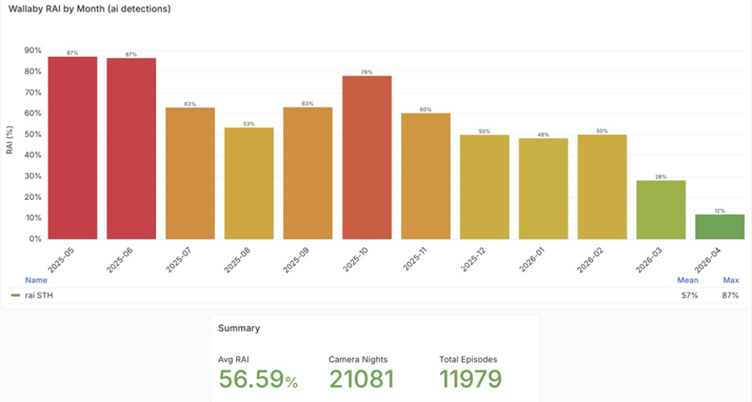
▶ Figure 1: Blocks 2- 6 (aka STH block) Relative Abundance index of wallabies over time since the beginning of the operation.
Overall, the RAI population trend over time tells a powerful story. It covers the period from the start of the ground-based hunting operation (May 2025) and the high relative abundance measure that was captured at that time, the moderate impact of the targeted July 2025 1080 operation, the recovery post the July operation and then the more significant impact of the March 2026 – combined with the 1080 cut-foliage and cereal treatment approach. The Challenger point treatment trial also featured in October/ November 2025 but due to the small size of the site (10 per cent), we believe this local reduction would have had less of a significant impact on the overall RAI for the south and reduction may be the result of environmental factors.
Noting the potential recovery trajectory, the team recognised the importance of having hunters quickly returning to work in the southern treatment block, initially focusing on the buffers zones where no toxins were deployed to prevent reinvasion and natural recovery. A further 188 wallabies have been dispatched thus far, predominantly on the fringes of the treatment area as per the map below.
▶ Map 1: Dispatch locations of wallabies for date range 30 March to 7 June 2026.
While both the hunting only approach of block one (and residential areas of blocks 2 and 3) and the combined hunting plus toxin treatment approach for blocks 2-6 have resulted in a significant reduction of the population.
Figure 2: shows the RAI for block one of wallabies over time, demonstrating the long tail that occurs when targeting the last surviving individuals in a population following rapid reduction when control begins.
While it took four months to reduce the population down to less than a quarter, the RAI hovered at 3 per cent since November, with a slight increase following an enforced summer shutdown period. Hunting operations resumed in March, with half a dozen individuals being successfully removed, reducing the RAI for June to 1 per cent.
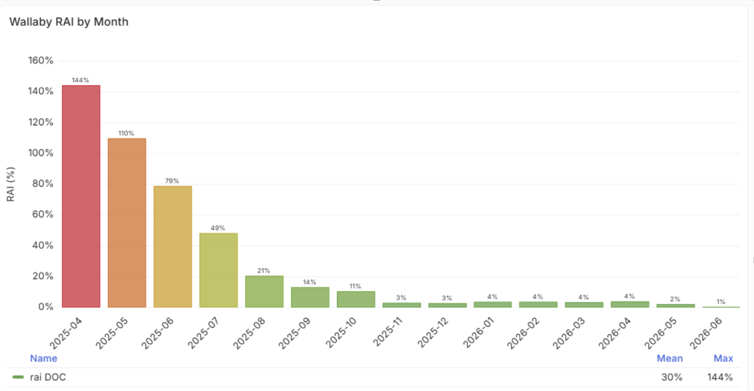
▶ Figure 2: Block 1 (aka DOC block) Relative abundance index of wallabies over time since the beginning of the operation.
Figure 3a below reveals the distribution of the last remaining individual swamp wallabies in block one in April, reflecting what is believed to be individuals in discrete territories. While Figure 3b shows recent successful dispatches from a number of these same territories.
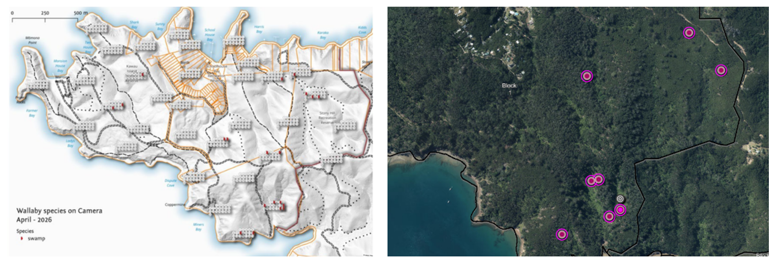
▶ Figure 3a (left): Distribution of wallaby species on camera in block one.
▶ Figure 3b (Right): Wallaby dispatches in block one between 9 May-7 June 2026.
Possum Update
The aforementioned data relates to the wallaby programme – but we cannot forget the possums.
While South Cove has continued to record zero detections on the fixed camera network for possums since the beginning of the year, and has been swept by the possum dog team twice, block one has recorded single detections, likely by a couple of individuals in the peninsula locations adjacent to School House Bay and Harris Bay. Two possums have since been dispatched in the months of April and May and we are down to a single detection thus far for the month of June. Our possum team will continue to monitor.
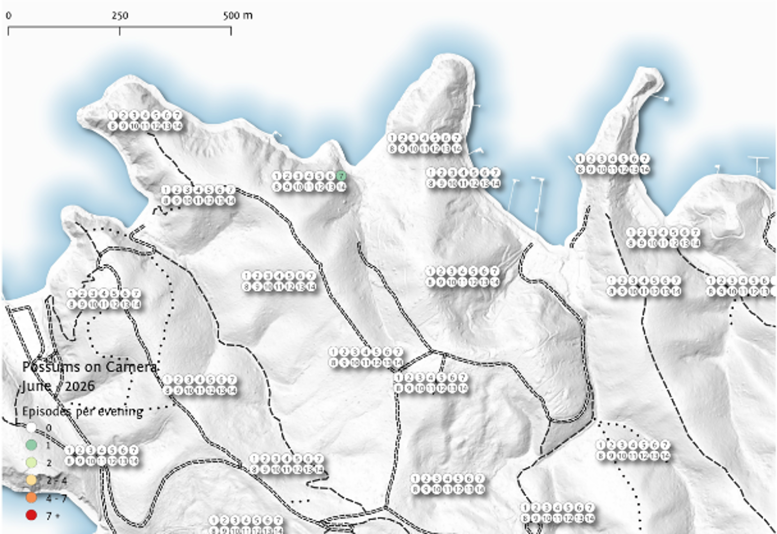
▶ Figure 4: distribution of possums detected on camera in block one for month of June.
Tīkapa Moana / Hauraki Gulf: The Seabird Capital of the world is on your doorstep
Tīkapa Moana / Hauraki Gulf is an internationally recognised hotspot for seabird diversity. About 70 species breed and forage there, and five breed nowhere else in the world.
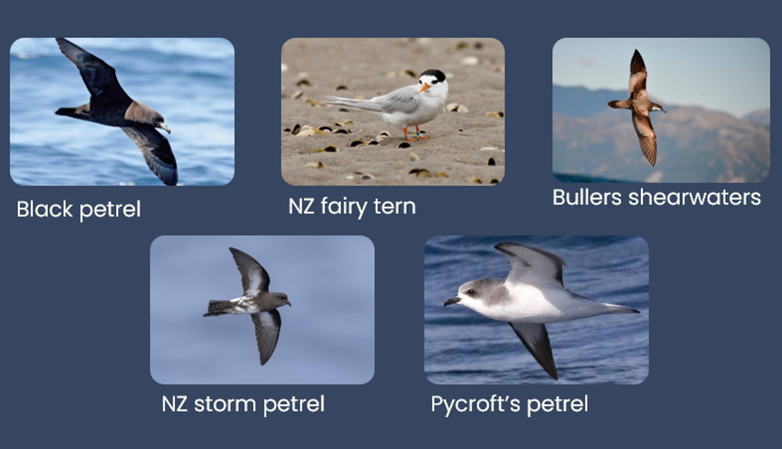
▶ Figure 5: Five seabirds that breed only in the Hauraki Gulf (Black petrel, NZ fairy tern, Bullers shearwaters, NZ storm petrel, Pycroft’s petrel).
Unfortunately, most of our seabirds are ‘Threatened’ or ‘At Risk’, requiring urgent protection, management and restoration.
Invitation to join an online community event Tuesday 14 July at 7pm
Join us online via this Microsoft teams link on the evening of Tuesday 14th July to learn more about how you can contribute to the protection of the coastal marine environment for Kawau Island. Alternatively, if you wish to receive a calendar invite to the online event, email kawauislandproject@aucklandcouncil.govt.nz
Item 1: Get to know your local seabirds
Join Maíra Fessardi, Auckland Council Seabird and Terrestrial Scientist, to hear about the Seabird Monitoring and Research Programme established for Tīkapa Moana / the Hauraki Gulf. This long-term (>10 years) programme aims to increase our knowledge on:
- the presence, health and trends of seabird populations in the Auckland region
- the factors affecting their population distributions
- trends to advise and develop restoration actions to improve their conservation statuses.
Opportunities to contribute to the current knowledgebase will be discussed, including the potential for Little Penguin / Kororā (Eudyptula minor) monitoring for interested members of the community.
Item 2: Interconnection between land and sea: introduction to eDNA coastal monitoring of island ecosystems
IslandScope is a global initiative led by Island Conservation that uses environmental DNA (eDNA) to better understand the connections between land and sea, providing communities with marine biodiversity data to support the conservation and management of island ecosystems. Dr. Grace Klinges, a molecular ecologist specializing in the use of genetic tools to measure ecosystem change, works with communities to develop eDNA monitoring approaches that are scientifically robust and locally meaningful. Grace is seeking input from the Kawau community to better understand local priorities for marine detection and to produce information relevant to long-term stewardship of the Hauraki Gulf.
Invitation to learn how to use eDNA coastal monitoring kits in the field. Mansion House Bay. Sunday 26th July 10:30am-1:30pm
Following on from the online introduction to the use of eDNA as a costal monitoring tool, we are extending an invitation to Kawau Island community members to join Grace in the field at Mansion House Bay, where she will demonstrate the use of the kits and invite community members to assist with the sampling efforts. This will be followed by hot refreshments, soup and scones at the Mansion House Cage where Grace will explain what we might expect to find and how the findings will be shared back with the community. Further monitoring efforts will be required on a seasonal basis, so don’t hesitate to let us know if you can continue to help out.
Email expressions of interest/ register numbers attending to kawauislandproject@aucklandcouncil.govt.nz This will help inform numbers for the day.
Caught on camera: Unexpected visitors detected via the wildlife camera network
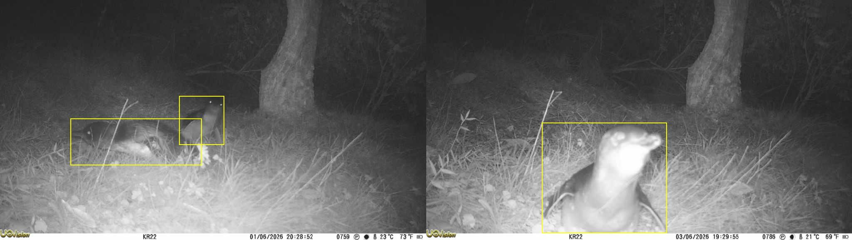
▶ Photo 1a and 1b Little Penguins in Miners Bay.
The team were excited to see these recent visitors detected by our wildlife camera network at Miners Bay. Little Penguins / Kororā (Eudyptula minor) have been seen regularly travelling backwards and forwards and one penguin in particular likes to take a good look at the camera on his/her way past. The Hauraki Gulf is an important breeding area for Kororā, supporting numerous colonies in its sheltered islands and coastal habitats. While Kororā are primarily nocturnal on land, they are not shy of human settlement and as many Kawau folk know, they nest beneath and around coastal buildings—often keeping residents awake with their noisy calls at night https://www.nzbirdsonline.org.nz/species/little-penguin
Smarter gardening for a pest-free Kawau
Autumn is a popular time to tidy and prepare gardens for planting, but moving plants, soil, compost, and equipment from the mainland can unintentionally spread pests. To help protect Kawau:
- Carefully check bags, boxes, pot plants, and supplies for insects, eggs, or rodent signs.
- Thoroughly soak potted plants before transport.
- Where possible, buy plants from accredited Plant Pass producers.
- Clean soil from boots, tools, pots, trailers, and soak pots before moving.
- Ensure all soil, compost, and potting mix is transported in sealed, unopened bags from suppliers with good biosecurity practices.
- Store gardening gear off the ground prior to transport to reduce the risk of pest hitchhikers
Talk to your transport operator ahead of time to confirm the biosecurity requirements. Biosecurity dog teams at Sandspit Wharf are regularly checking barges for pests like rodents and invasive ants and can be contacted by emailing biosecurity@aucklandcouncil.govt.nz if you need further advice.
Previous newsletters
- 15 May 2026 - Pest Free Kawau May newsletter - Operations update, smart gardening and support for weed control (PDF 921KB)
- 25 February 2026 - Pest Free Kawau February newsletter - Kiwi Survey, Findings from the treatment trial, operational next steps (PDF 5.40MB)
- 16 December 2025 - Pest Free Kawau December newsletter - operation update, pause of operations during summer and more (PDF 5MB)
- 17 October 2025 - Pest Free Kawau October newsletter - operation update and progress updates (PDF 1MB)
- 22 August 2025 - Pest Free Kawau August newsletter - operation update, kiwi survey, kiwi avoidance training and more (PDF 1MB)
- 11 July 2025 - Pest Free Kawau July newsletter - Important operations update, fun Kiwi footage and more (PDF 1.27MB)
- 13 June 2025 - Operation update, Community safety, June Community Forum meeting and more (PDF 871KB)
- 13 May 2025 - Operational update and project factsheet (PDF 946KB)
- 22 April 2025 - Project update, Argentine Ant work and success, and April Community Forum meeting (PDF 1MB)
- 13 February 2025 - February Community Forum meeting and NZ Nature Fund campaign (PDF 277KB)
- 31 January 2025 - Supplier announcement and project updates (PDF 1.2MB)
- 17 December 2024 - December Community Forum Meeting And Kiwi On Kawau (PDF 577KB)
- 25 October 2024 - Pest Free Kawau October update- New project video and webpages, dotterel season, and ecosystem monitoring (PDF 1.1MB)
- 13 September 2024 - Project update, Argentine Ants incursion and getting ready for Summer (PDF 1.2MB)
- 19 July 2024 - Project update, funding and property permissions and guides (PDF 705KB)
- 21 May 2024 - Community Forum Update And Stoat Detection Surveys (PDF 415KB)
- 27 March 2024 - Community Forum Reminder And Highlighting Kawau Community Conservation (PDF 705KB)
- 1 March 2024 - Adapting Our Approach In Response To Community Feedback (PDF 875KB)

